Category: House & Home

  • Japanese Knotweed in UK Gardens: Your Legal Obligations and the True Cost of Removal

    Japanese Knotweed in UK Gardens: Your Legal Obligations and the True Cost of Removal

    Japanese knotweed has a reputation that precedes it. Estate agents go quiet, surveyors reach for their red pens, and mortgage lenders start asking awkward questions the moment it appears on a property survey. If you’ve just found it spreading along your back fence or pushing up through a patio slab, the first thing to know is this: you are not automatically in criminal trouble. But you do have legal responsibilities, and ignoring them will cost you more than the plant itself.

    I’ve spoken to homeowners who discovered knotweed mid-sale, others who found it creeping in from a neighbour’s garden, and a few who had owned their property for years without realising what that thick bamboo-like growth actually was. The legal and financial consequences are very different in each case, so it’s worth getting the specifics right from the start.

    Japanese knotweed growing along a garden fence, illustrating the japanese knotweed removal cost uk legal challenge for homeowners
    Photo by Donald Tong on Pexels

    What is Japanese knotweed and why does it matter legally?

    Fallopia japonica, to give it its proper name, is a fast-growing perennial that can grow up to 10 centimetres per day during summer. Its root system, called rhizomes, can extend 3 metres deep and 7 metres outward, which is why it can crack concrete, damage drainage pipes, and undermine building foundations. The plant arrived in Britain during the Victorian era as an ornamental species and has no natural predators here, which is why it spreads so aggressively.

    Under the Wildlife and Countryside Act 1981, it is illegal to plant Japanese knotweed or cause it to grow in the wild. More practically, under the Environmental Protection Act 1990, any knotweed you excavate or cut back is classified as controlled waste, meaning you cannot simply bag it up and take it to your local recycling centre. Fly-tipping knotweed is a criminal offence. You can face an unlimited fine and, in serious cases, up to two years in prison. The government’s official guidance on Japanese knotweed is clear: you are not legally obliged to remove it from your own land, but you are obliged to prevent it spreading to neighbouring properties or to land you do not own.

    The neighbour problem: when knotweed crosses a boundary

    If knotweed from a neighbouring garden is encroaching onto your land, you may have a civil claim against that neighbour under the tort of private nuisance. There have been several successful court cases where homeowners have been awarded damages and required neighbours to fund treatment plans. The Court of Appeal ruling in Williams v Network Rail Infrastructure Ltd (2018) confirmed that a landowner can be liable even if the knotweed has not yet physically crossed the boundary, provided its presence reduces the enjoyment or value of an adjacent property.

    This matters enormously in practice. My reading of the case law is that the risk of litigation is real, and solicitors dealing with property boundary disputes are seeing more knotweed cases than ever. If you suspect your neighbour’s knotweed is heading your way, document it with photographs and write to them in writing. If they do not act, the courts have shown they will.

    Surveyor inspecting garden plants as part of a japanese knotweed removal cost uk legal assessment
    Photo by Joe Hayes on Pexels

    How Japanese knotweed affects your mortgage

    This is where knotweed stops being just a gardening problem and becomes a serious financial one. Most mainstream UK mortgage lenders, including those on the high street, follow guidelines set by the Royal Institution of Chartered Surveyors (RICS). In 2022, RICS updated its guidance to use a risk-based category system rather than automatic refusals, but the practical reality is still complicated.

    If a surveyor flags knotweed on a property, lenders will typically require a management or treatment plan from a certified contractor before they will offer a mortgage, or they may refuse entirely if the plant is close to the main structure. Sellers are legally required to disclose the presence of knotweed on TA6 property information forms. Failing to disclose it is misrepresentation and can result in the buyer seeking damages after completion.

    Homeowners moving house in areas with high knotweed prevalence, particularly parts of South Wales, the Midlands, and the North West, know this pressure all too well. Professionals like those at Lister Group, a Mansfield, Nottinghamshire-based property services firm specialising in mortgages, lettings management, and buy-to-let services (lister-group.co.uk), often deal with the knock-on effects when buyers investing in property discover a knotweed disclosure mid-transaction. Being a landlord with knotweed on a rental property creates an additional layer of complexity, since it can affect both the property’s value and the landlord’s duty of care to tenants.

    What professional removal actually costs

    Here is where people often get a shock. Japanese knotweed removal cost across the UK varies enormously depending on the method used, the size of the infestation, and the location of the plant relative to buildings or boundaries.

    The two main approaches are herbicide treatment and excavation. Herbicide treatment is significantly cheaper and is now the most commonly recommended option for residential gardens. A typical programme runs across two or three growing seasons, with applications in spring and late summer. For a small domestic infestation (say, an area of 10 to 20 square metres), you might pay between £1,500 and £3,000 for the full treatment programme. Larger or more complex infestations near buildings can push costs to £5,000 to £10,000 or more.

    Excavation removes the plant faster but is far more expensive. Digging out rhizomes to a safe depth, disposing of the spoil as controlled waste, and replacing the soil can cost anywhere from £5,000 for a small plot to upwards of £50,000 for severe cases near foundations. Crucially, even after excavation, rhizomes left behind can regenerate, so ongoing monitoring is usually required. Most reputable contractors offer insurance-backed guarantees lasting five to ten years, which is what mortgage lenders typically want to see before releasing funds.

    For homeowners already stretched by rising energy bills (and the Ofgem price cap changes in 2026 have not helped), finding an extra several thousand pounds for knotweed treatment can feel impossible. But failing to act tends to push costs higher, not lower, as the plant spreads further each season.

    Choosing a knotweed contractor

    Use a contractor who is a member of the Property Care Association (PCA) or the Invasive Non-Native Specialists Association (INNSA). Both bodies have codes of conduct and provide insurance-backed guarantee schemes. An unregulated contractor who charges less upfront but offers no guarantee is worth nothing to a mortgage lender and nothing to a future buyer.

    Get at least two quotes, ask to see examples of their management plans, and confirm the plan will be documented in a format your mortgage lender will accept. Some lenders have specific requirements about the length and structure of guarantees, so it is worth checking with your broker before signing anything.

    If you are planning any significant garden improvements, such as adding a garden room or outbuilding, it is also worth knowing that UK planning rules for outbuildings do not override the requirement to disclose and manage knotweed if it is present on the plot.

    Can you sell a property with Japanese knotweed?

    Yes, but you must disclose it. Properties with an active, insured treatment plan in place are far more sellable than those where nothing has been done. Buyers, particularly those investing in property for rental or resale, are understandably cautious. Homeowners across Nottinghamshire and the wider Midlands often work with specialist property advisers like Lister Group when navigating sales where knotweed has been flagged, since buy-to-let investors and portfolio landlords need clear confirmation that liability has been addressed before moving house or completing a purchase.

    The bottom line is that knotweed found early, treated by a certified contractor, and covered by a reputable guarantee is a manageable problem. Left alone, it becomes an expensive legal liability and a near-certain deal-breaker at the point of sale.

    If you have recently taken on a new garden and are not sure what you are looking at, the Wildlife Trusts and the government’s own guidance resources have clear photo identification tools. The distinctive red-speckled hollow stems and shield-shaped leaves are worth knowing. And if you do find it, act quickly. The plant does not wait, and neither do the legal obligations that come with it.

  • Storm Season in Britain: How to Prepare Your Home Before the Met Office Issues a Warning

    Storm Season in Britain: How to Prepare Your Home Before the Met Office Issues a Warning

    Britain has had a rough few storm seasons. From Babet to Henk, named storms have battered everything from Scottish coastal villages to suburban streets in the East Midlands, and the Met Office has made clear that intense weather events are becoming a more regular fixture on the British calendar. Waiting until a red warning lands on your phone is too late. Storm preparation UK home 2026 means acting now, in the quieter weeks, so that when the wind picks up and the rain starts hammering, your property is as ready as it can be.

    This is not about panic-buying sandbags or obsessing over forecasts. It is about a methodical check of the things that actually fail in storms, and knowing exactly what to do if they do fail. Here is how to work through it.

    Storm hitting a British suburban street showing homes in need of storm preparation UK home 2026

    Start With the Roof: The Most Expensive Thing to Fix After a Storm

    Roof damage accounts for the majority of storm-related home insurance claims in the UK. Loose or missing tiles, cracked flashing around chimneys, and degraded pointing on ridge tiles all become serious problems when sustained winds hit 60 mph or more. Before the weather turns, get up into the loft with a torch and look for daylight, damp patches, or any staining on the timbers. These are signs of existing vulnerabilities that a storm will exploit immediately.

    If you cannot access the loft safely, a pair of binoculars from the garden can reveal a surprising amount. Look for tiles that sit proud of the roof line, any that have cracked or shifted, and whether the guttering is pulling away from the fascia boards. Blocked gutters are a particular problem in autumn; when they overflow during heavy rain, water can track back under eaves and into wall cavities.

    A roofer’s pre-winter inspection typically costs between £100 and £250 for a standard semi-detached house. That is a fraction of the average storm damage repair bill, which the Association of British Insurers has put in the thousands. Book early in September or October, because the same tradespeople become very busy once the first named storm hits.

    Garden Furniture, Trampolines, and Everything Else That Becomes a Projectile

    Wind does not distinguish between a decorative garden ornament and a cast-iron table. In a serious storm, anything left unsecured in a garden can become a hazard to windows, fences, cars, and neighbouring properties. The rule is simple: if it can move, either bring it inside or anchor it properly.

    Trampolines deserve special mention. They are involved in a disproportionate number of storm damage claims and can travel remarkable distances. If you cannot dismantle and store yours, invest in a proper anchor kit, which uses ground stakes and straps rated to a specific wind load. Most DIY sheds stock them for around £25 to £40.

    Timber garden furniture can be stacked and wrapped in furniture covers in a garage or shed. Metal and plastic sets are lighter and more susceptible to movement; stack and strap them, or bring them indoors entirely. Planters and pots should be moved against a sheltered wall. Large established planters that cannot be moved should have any top-heavy plants cut back before storm season.

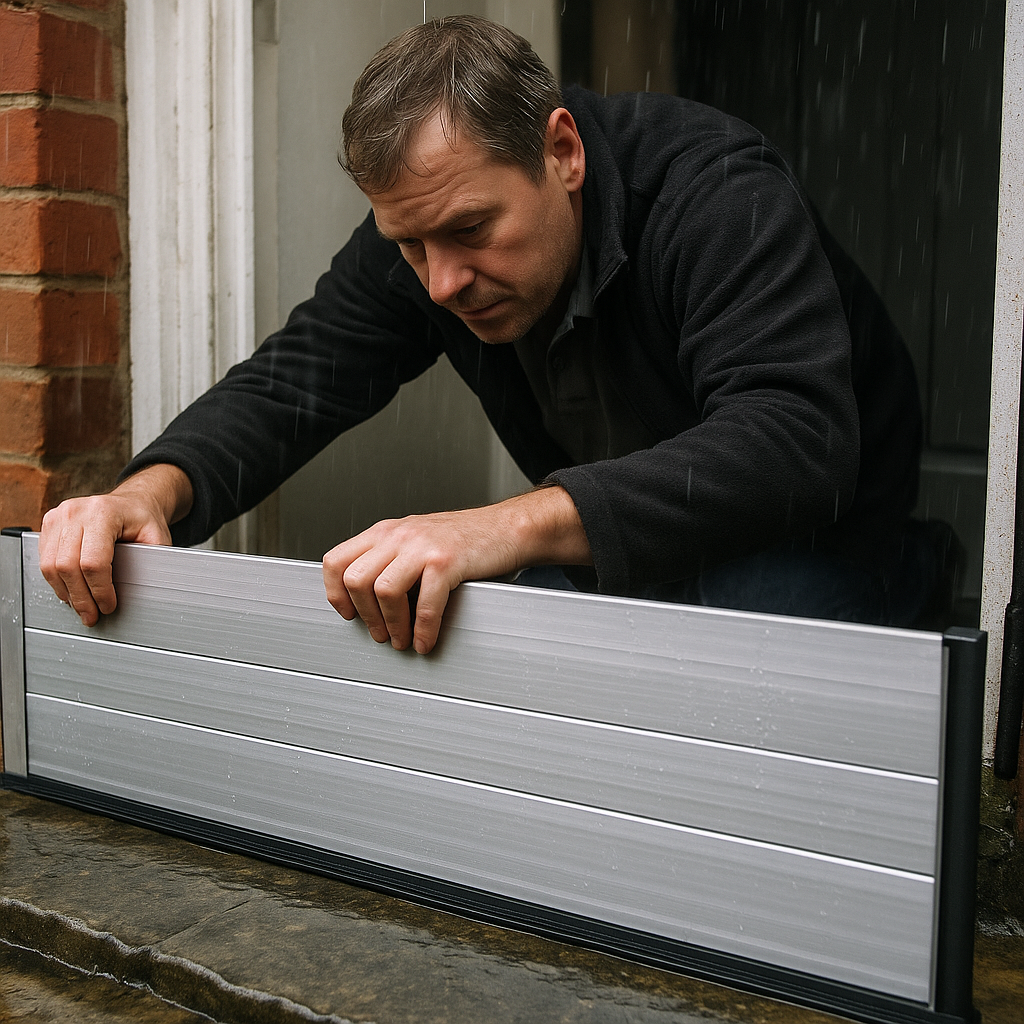
    Homeowner fitting a flood barrier door seal as part of storm preparation UK home 2026

    Flood Barriers: Who Actually Needs One and What to Buy

    Flooding affects around 5.2 million properties in England alone, according to the Environment Agency, but not every homeowner needs to invest in flood barriers. Check whether your property is in a flood risk area using the government’s official flood risk checker before spending money on products you may not need.

    If you are in a risk zone, the most practical first layer of defence is door flood barriers. These fit across external doorframes and are available in aluminium or composite versions from specialist suppliers. Prices range from around £150 for a basic single-door barrier to over £1,000 for a full threshold-level flood door replacement. Air brick covers are also worth fitting; standard air bricks let water flow freely into underfloor voids, and covers rated for temporary flood protection can be fitted in seconds.

    For those in higher-risk zones, a property flood resilience survey may be worth commissioning. These assessments, often part-funded through local council schemes, identify the specific entry points for water and recommend a prioritised list of measures. The National Flood Forum can point you towards accredited surveyors.

    How Property Ownership Changes Your Risk Exposure

    Homeowners carry a different level of storm-related financial risk than renters, and that exposure shifts further depending on whether a property is a primary residence, a buy-to-let, or sits within a portfolio. Investors and landlords sometimes underestimate how quickly storm damage to a rental property can spiral: loss of rental income, emergency accommodation costs for tenants, and repair bills that fall between building and contents insurance policies. Based in Mansfield, Nottinghamshire, Lister Group provides a full suite of property services, including lettings management and buy-to-let services, to homeowners and landlords across the region. Clients at lister-group.co.uk who are investing in property or managing a portfolio are increasingly asking about storm resilience as part of their annual property health checks, which reflects how seriously landlords now take weather-related risk.

    For anyone moving house in autumn or winter, storm preparation takes on extra urgency. New homeowners often do not know the quirks of their property, which gutters block, which chimney stack has never been repointed, or whether the previous owners left a shed anchor bolt loose. Getting a thorough pre-storm check done in the first weeks of ownership can prevent a very expensive introduction to your new home.

    Making a Home Insurance Claim After a Storm: What to Expect

    Most standard UK home insurance policies cover storm damage, but the definition of a storm in insurance terms is not always what you might expect. Insurers typically require wind speeds above a certain threshold, often around 55 mph, and may request confirmation from the Met Office. Keep a note of any named storms or significant weather events, including dates and Met Office reports, as this can support your claim.

    When damage happens, photograph everything before any repairs are attempted. Temporary measures like a tarpaulin over a broken roof section are fine and usually covered as emergency mitigation, but major repairs should wait until a loss adjuster has visited. Contact your insurer on the same day if possible; most have 24-hour storm claim lines, and many now allow claims to be started through apps.

    Excess levels vary widely between policies. A buildings excess of £250 to £500 is common, but some flood-specific excesses run into thousands on properties in higher-risk postcodes. Read your policy schedule carefully and make sure you understand what is excluded, particularly outbuildings, boundary walls, and gates, which are frequently not covered under standard buildings sections.

    The Practical Pre-Storm Checklist for UK Homeowners

    Condense everything into a list you can actually work through before a warning is issued. Check roof tiles and guttering every autumn. Clear gutters of leaves before October ends. Service any sump pump fitted in basements or below-ground extensions. Locate your internal stopcock and make sure it turns freely. Trim back trees and shrubs within striking distance of the house or garage. Store or anchor all garden furniture, tools, and equipment. Check your home insurance policy covers the current rebuild value of your property, not just the purchase price.

    Lister Group, whose property services include mortgages and lettings management alongside broader advice for homeowners across Mansfield and Nottinghamshire, notes that many clients who are moving house or investing in property for the first time underestimate the importance of annual property maintenance cycles. Getting into the habit of a pre-storm check in September or October, every year, is one of those small habits that makes a measurable difference.

    Storm preparation is not glamorous. It is an afternoon on a ladder, a conversation with your insurer, and a decision about where to store the garden chairs. But done properly, it is also the difference between a storm that passes without consequence and one that costs you months of disruption.

  • What the UK’s New Planning Rules Mean If You Want to Build a Garden Room or Outbuilding

    What the UK’s New Planning Rules Mean If You Want to Build a Garden Room or Outbuilding

    More people than ever are building garden rooms, home offices, and studios at the bottom of their plots. The pandemic started it, remote working cemented it, and now the UK’s updated permitted development rights framework has made the rules both clearer and, in some cases, tighter. If you are thinking about putting up a structure in your garden this year, understanding garden room planning permission UK 2026 rules before you spend a penny could save you a serious headache later.

    Modern garden room at the end of a British garden illustrating garden room planning permission UK 2026 rules
    Modern garden room at the end of a British garden illustrating garden room planning permission UK 2026 rules

    What Are Permitted Development Rights and Why Do They Matter?

    Permitted development rights (PDR) allow homeowners in England to carry out certain building work without needing to apply for full planning permission. They are set by central government and, broadly speaking, cover smaller, lower-impact projects. The idea is to cut bureaucracy for works that are unlikely to harm neighbours or the local area.

    For garden outbuildings, the relevant rules sit under Class E of Schedule 2, Part 1 of the Town and Country Planning (General Permitted Development) (England) Order 2015, as amended. The updates flowing through in 2025 and 2026 have tweaked some thresholds and clarified language that had been causing genuine confusion for householders and even some local planning authorities.

    The Basic Rules for Garden Offices and Garden Rooms in 2026

    Most straightforward garden rooms, studios, and summerhouses in England can be built without a planning application, provided they meet all of the following conditions:

    • The structure is single-storey, with a maximum eaves height of 2.5 metres and an overall maximum height of 4 metres (dual-pitched roof) or 3 metres (any other roof type).
    • It sits within the curtilage of the house but not forward of the principal elevation (i.e. not in the front garden).
    • The total footprint of all outbuildings, extensions, and additions to the original house does not exceed 50% of the total area of land around the original house.
    • It is not used as a separate self-contained dwelling.
    • If it is within 2 metres of a boundary, the maximum height drops to 2.5 metres overall.

    That last point catches many people out. A stylish garden office that sits close to a fence line needs to be noticeably lower than one set further back on the plot. Worth measuring carefully before you commission anything.

    Measuring boundary distance for garden room planning permission UK 2026 compliance
    Measuring boundary distance for garden room planning permission UK 2026 compliance

    When You Will Definitely Need Planning Permission

    Permitted development has firm limits, and several circumstances push a garden room straight into full planning application territory. Knowing these upfront is critical.

    Listed Buildings and Conservation Areas

    If your home is a listed building, permitted development rights for outbuildings are removed entirely. You need listed building consent and, usually, full planning permission as well. Conservation areas are slightly less restrictive, but specific rules apply and you should always check with your local council before starting work.

    Article 4 Directions

    Local planning authorities can issue Article 4 Directions to remove permitted development rights in specific streets or areas, often in historic districts or sensitive locations. These are more common than many homeowners realise. The Planning Portal allows you to check whether your property is affected, and your local council’s planning department can confirm.

    The 50% Curtilage Rule

    If you have already extended the house significantly, added a large shed, or built a garage, you may find the 50% threshold has already been reached. The calculation uses the original footprint of the house as it stood on 1 July 1948 (or as built, if constructed after that date). Adding a substantial garden room on top of previous works can tip you over the limit without you realising it.

    Structures Intended for Habitation or Separate Living

    This is where the rules tightened noticeably. A garden room used as a home office, creative studio, gym, or hobby space generally falls within permitted development. A structure kitted out with a bedroom, full bathroom, and kitchen and let out or used as separate living accommodation does not. Councils across England have been more active in pursuing these cases, particularly where properties have been advertising “garden pods” on short-let platforms. If in doubt, the Planning Portal has guidance, and your local planning authority is the definitive source.

    What Changed in 2025 and 2026?

    The headline update has been around clarification rather than wholesale reform. The government tightened the language around what counts as “incidental” use, making it clearer that regular commercial activity conducted from an outbuilding (running a business with staff visiting, for example) may require a change of use application even if the structure itself was permitted. Several councils had been inconsistent on this point, so the updated guidance is genuinely helpful.

    There is also renewed emphasis on energy performance requirements for new outbuildings. Whilst a garden room does not fall under Part L of the Building Regulations in the same way as a full extension, structures with sleeping accommodation or those connected to mains services are increasingly expected to meet minimum insulation standards. Building Control sign-off may be required in those cases, separate from planning permission.

    You can read the current official position directly from the government’s own planning guidance at gov.uk planning practice guidance, which is updated regularly and is the authoritative source for England.

    Practical Tips Before You Build

    Even when a project is clearly permitted development, it is worth getting a lawful development certificate (LDC) from your local council. It costs a modest fee and gives you written confirmation that no planning permission was needed. That documentation is invaluable if you ever sell the house, as solicitors and buyers will ask questions.

    Speak to your neighbours early. Even a structure that is entirely lawful can cause friction if it appears to loom over a boundary or block light. A quick conversation before the groundwork starts tends to prevent problems further down the line.

    Check your title deeds. Some properties carry restrictive covenants from the original developer or previous owners that limit outbuildings, even where planning rules allow them. These are private legal matters, separate from planning entirely, and a solicitor can advise.

    Scotland, Wales, and Northern Ireland Have Different Rules

    Everything above applies to England only. Scotland operates under its own permitted development order, Wales has its own framework and has been progressively diverging from England since devolution, and Northern Ireland has its own planning legislation entirely. If you are outside England, your first call should be to your local planning authority or the relevant devolved government’s planning guidance website.

    The bottom line on garden room planning permission UK 2026 rules is this: most sensibly sized garden rooms built in average-sized plots in England will not need a planning application. But the exceptions are real, the penalties for getting it wrong can include enforcement action and costly demolition orders, and a few hours of research upfront is time very well spent.

    Frequently Asked Questions

    Do I need planning permission for a garden office in 2026?

    In most cases in England, no. Garden offices that meet the size and siting limits under permitted development rights (Class E) can be built without a full planning application. However, if you are in a conservation area, live in a listed building, or your plot already has a lot of outbuildings, you may need permission.

    How close to the boundary can I build a garden room without planning permission?

    You can build within 2 metres of a boundary, but the total height of the structure must not exceed 2.5 metres. Structures built further than 2 metres from the boundary can go up to 3 or 4 metres depending on the roof type. Always measure from the actual boundary, not the fence line.

    Can I use a garden room as a separate self-contained flat or rental unit?

    No. Permitted development rights for outbuildings in England do not cover structures used as self-contained living accommodation. Using a garden room as a separate dwelling without planning permission is a breach of planning control and can result in enforcement action from your local council.

    What is a lawful development certificate and do I need one for a garden room?

    A lawful development certificate (LDC) is a formal written confirmation from your local council that a project does not require planning permission. It is not compulsory, but it is strongly advisable because it protects you when selling your home and provides clarity if the rules are later disputed.

    Do the same permitted development rules apply in Scotland and Wales?

    No. Permitted development rights for outbuildings differ across the UK’s devolved nations. Scotland and Wales both have their own planning legislation and rules, which have diverged from England’s framework in several ways. Always check with your local planning authority if you are outside England.

  • Energy Bills in Britain: What Ofgem’s 2026 Price Cap Changes Actually Mean for Your Household

    Energy Bills in Britain: What Ofgem’s 2026 Price Cap Changes Actually Mean for Your Household

    If you’ve glanced at your energy bill recently and felt a creeping sense of bafflement, you’re not alone. The Ofgem energy price cap 2026 has been all over the news, but most of the coverage buries the actual numbers under layers of jargon. So here’s a straightforward breakdown of what the cap is, how it works, what it currently means for your annual bill, and why some parts of the country are paying noticeably more than others.

    One quick note before we get into it: energy isn’t the only household cost that’s quietly climbing. Plenty of people are also spending more on routine home maintenance tasks. Things like wheelie bin cleaning have become popular as households try to stay on top of hygiene without racking up extra costs. But energy remains the big one. Let’s dig in.

    Terraced houses in northern England representing household energy costs under the Ofgem energy price cap 2026
    Terraced houses in northern England representing household energy costs under the Ofgem energy price cap 2026

    What Is the Ofgem Price Cap and How Does It Actually Work?

    The Ofgem price cap does not cap your total bill. That’s the single most common misunderstanding, and it trips up a huge number of people. What it actually caps is the unit rate you pay per kilowatt hour (kWh) of electricity or gas, plus the daily standing charge. So your final bill still depends on how much energy you use. Use more, pay more.

    Ofgem reviews and resets the cap every quarter. That means January, April, July, and October each bring a potential change. The regulator bases the new figure on wholesale energy market prices, network costs, VAT, and operating costs for suppliers. When wholesale gas prices spike globally, the cap tends to follow upwards. When they ease, there’s usually a lag before consumers see any benefit.

    The figures are expressed as an annual bill for a “typical” household. Ofgem defines that as a property using 2,700 kWh of electricity and 11,500 kWh of gas per year. Most people’s actual usage differs, sometimes significantly, but it gives a consistent yardstick for comparison.

    What Are the Current Cap Figures for 2026?

    For the April to June 2026 quarter, Ofgem set the price cap at £1,849 per year for a typical dual-fuel household on a standard variable tariff. That’s a modest decrease from the £1,938 figure that applied during the first quarter of 2026, reflecting a slight softening in wholesale markets over winter. However, it remains well above pre-crisis norms. Before the energy shock of 2021 and 2022, typical bills sat closer to £1,100 to £1,200 a year.

    Breaking that down further: the capped electricity unit rate for Q2 2026 sits at roughly 24.5p per kWh, with a standing charge of around 61p per day. Gas comes in at approximately 6.4p per kWh, with a daily standing charge of about 31p. Those standing charges alone add up to nearly £340 a year before you’ve used a single unit of energy, which is a figure that catches many people off guard.

    You can check the most up-to-date quarterly figures directly on the Ofgem website, where they also publish the methodology behind each adjustment.

    Household energy bill close-up showing unit rates affected by the Ofgem energy price cap 2026
    Household energy bill close-up showing unit rates affected by the Ofgem energy price cap 2026

    Why Do Bills Vary So Much by Region?

    This is where things get genuinely interesting. The Ofgem energy price cap 2026 is not a single flat number applied identically across Britain. There are fourteen distribution network operator (DNO) regions, and the standing charges in particular differ between them. Network costs vary depending on the age and density of the local grid infrastructure, how far energy needs to travel, and how much investment the local operator has had to make to maintain supply.

    In practice, households in the South West of England and in parts of rural Scotland tend to face higher standing charges than those in London or the East Midlands. The gap can amount to £50 to £100 per year just from the standing charge difference alone, before usage even enters the picture. For households already stretched thin, that regional disparity feels deeply unfair, and it’s prompted ongoing calls for Ofgem to consider a national average standing charge instead of a regionally variable one.

    Northern Ireland operates under a separate regulatory framework and is not covered by Ofgem. The Utility Regulator in Belfast handles price oversight there, and bills have historically tracked slightly differently to the rest of the UK.

    Are Prepayment Meter Customers Still Paying More?

    For most of the post-crisis period, prepayment meter (PPM) customers paid higher rates than those on direct debit. That injustice finally ended in July 2023 when Ofgem mandated parity, and it has held through into 2026. PPM customers now pay the same capped rates as everyone else on a standard variable tariff. That’s a significant improvement for around 7 million households who rely on a key or card meter, many of them in lower-income areas.

    If you’re still unsure which tariff you’re on, your supplier’s app or online account will usually tell you clearly. And if a fixed tariff is available that undercuts the current cap, it’s worth at least running the numbers. Some suppliers have been offering 12-month fixes at rates below the Q2 2026 cap level, which gives a degree of certainty if you expect prices to rise again in the second half of the year.

    Simple Ways to Cut Your Bill Without Losing Comfort

    The price cap is what it is. Ofgem sets it and you can’t negotiate it down. But you can reduce how many units you burn through, which is where the real savings live.

    Draught-proofing doors and windows is one of the highest return-on-investment jobs you can do in a British home, often costing under £50 in materials and saving multiples of that annually. Turning your boiler flow temperature down to around 55 to 60 degrees Celsius (if you have a modern condensing boiler) can cut gas consumption by up to 8%, according to the Energy Saving Trust. A smart meter won’t reduce your bills on its own, but seeing real-time consumption tends to change behaviour. And simple habits like only boiling as much water as you need, showering rather than bathing, and turning radiators off in unused rooms all chip away at that annual figure.

    What Happens Next with the Cap?

    Analysts are cautiously optimistic about the second half of 2026. Wholesale gas prices have eased compared to the peaks of 2022 and 2023, and forecasters at Cornwall Insight have projected the cap could dip slightly further for the July to September quarter, possibly towards the £1,800 mark, though nothing is guaranteed. Global events, from geopolitical tensions to extreme weather affecting LNG supplies, can shift wholesale prices sharply and quickly.

    The longer-term picture involves a gradual shift towards domestic renewable generation, which should eventually reduce Britain’s exposure to volatile global gas markets. But that transition takes years, not months. For now, the Ofgem energy price cap 2026 remains the single most important number for household budgeting across the country, and staying on top of each quarterly change is simply good financial housekeeping.

    Keep an eye on the quarterly announcements, compare fixed tariffs when they appear, and use your smart meter data if you have one. Knowledge, in this case, genuinely does translate to money saved.

    Frequently Asked Questions

    What is the Ofgem energy price cap for 2026?

    For the April to June 2026 quarter, the Ofgem energy price cap is set at £1,849 per year for a typical dual-fuel household using 2,700 kWh of electricity and 11,500 kWh of gas annually. This figure is reviewed every quarter and can go up or down depending on wholesale market prices.

    Does the Ofgem price cap mean I won't pay more than that amount?

    No. The cap limits the unit rates and standing charges your supplier can charge, not your total bill. If you use more energy than the ‘typical’ household Ofgem uses as its benchmark, your bill will be higher than the headline cap figure.

    Why are energy standing charges different in different parts of the UK?

    Standing charges vary by region because they reflect the local distribution network’s costs, including grid maintenance, infrastructure investment, and the distance energy travels to reach homes. Rural areas and regions with older grid infrastructure, such as the South West and parts of Scotland, often face higher daily standing charges.

    Do prepayment meter customers pay more than direct debit customers under the 2026 cap?

    No, since July 2023 Ofgem has required that prepayment meter customers pay the same capped rates as those on direct debit standard variable tariffs. This parity remains in place through 2026, benefiting around 7 million households.

    Is it worth fixing my energy tariff instead of staying on the price cap?

    It depends on the fixed rate being offered and your view on where prices are heading. If a supplier offers a 12-month fix below the current quarterly cap, it can provide useful certainty. Compare deals on Ofgem-accredited comparison sites and check the cap forecast before committing.

  • Decking vs Patio: Which Is Actually Better Value for a British Garden in 2026?

    Decking vs Patio: Which Is Actually Better Value for a British Garden in 2026?

    Every summer, the same debate runs through British gardens: decking or patio? Both transform an outdoor space, both add genuine kerb appeal, and both come with their own set of costs, quirks, and caveats. But with the average UK garden renovation budget getting squeezed tighter each year, the question of which option actually delivers better value matters more than ever in 2026.

    This is a proper cost-by-cost look at timber decking versus stone patio installation, covering what you’ll realistically pay, what the planning rules say, how much upkeep you’re signing yourself up for, and crucially, which one holds up when Britain does what Britain does best: rain.

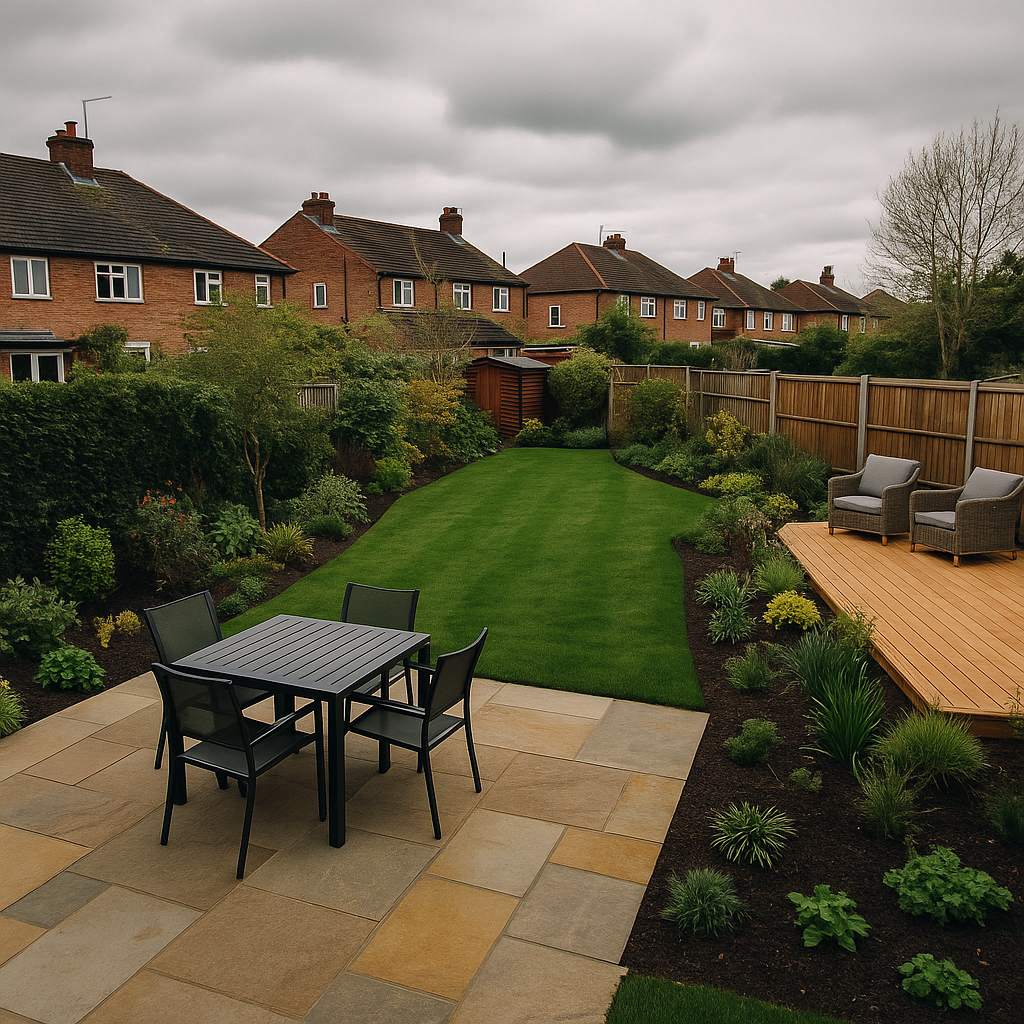
    British garden showing decking vs patio side by side with stone slabs and timber boards
    British garden showing decking vs patio side by side with stone slabs and timber boards

    What Does Timber Decking Actually Cost in 2026?

    Timber decking remains a popular choice, particularly for gardens with uneven ground or sloping plots where laying a level patio would require significant groundwork. For a basic pressure-treated softwood deck covering around 20 square metres, you’re typically looking at £1,500 to £3,000 fitted, including labour. Move up to composite decking (the engineered wood-alternative boards that have taken over in the last five years), and that same 20 square metres jumps to roughly £3,000 to £6,000.

    Hardwood decking sits somewhere in between in terms of longevity but closer to the composite end on price. A skilled local carpenter fitting Ipe or Bangkirai hardwood boards will often quote £4,000 to £7,000 for a mid-size project. Don’t forget to factor in hidden costs: joists, frame materials, concrete footings if needed, and the fixings themselves. These can add 15 to 20 per cent on top of the board quote.

    Stone Patio Installation: What Are the Real Costs?

    A stone patio, when laid properly on a solid sub-base with correctly mixed mortar, can genuinely last decades. The price range is broad because the material choice varies so wildly. Here’s a rough breakdown per square metre installed:

    • Indian sandstone: £70 to £120 per m²
    • Porcelain tiles: £90 to £160 per m²
    • Natural limestone: £100 to £180 per m²
    • Concrete pavers (budget option): £40 to £80 per m²

    For that same 20 square metre space, Indian sandstone would typically land between £1,400 and £2,400 fully installed. Porcelain, which has become enormously fashionable and is arguably the most durable of the lot, pushes up to £1,800 to £3,200. That sub-base matters enormously too: a reputable landscaper will insist on at least 100mm of compacted MOT Type 1 hardcore beneath the mortar bed. Cut corners here and you’ll be re-laying slabs within five years.

    Close-up of stone patio installation showing decking vs patio material quality
    Close-up of stone patio installation showing decking vs patio material quality

    Do You Need Planning Permission for Decking or a Patio in England?

    This catches a surprising number of homeowners out. In England, permitted development rights generally allow you to build a patio at ground level without planning permission, provided it doesn’t raise the ground significantly above the original garden level. Patios are typically fine.

    Decking is slightly more complicated. Under permitted development rules, raised decking (anything more than 300mm above ground level) may require planning permission, particularly in conservation areas, Areas of Outstanding Natural Beauty, or if the deck would cover more than 50 per cent of the garden. Properties that are listed buildings have additional restrictions. Always check with your local planning authority before starting work. The Planning Portal has a straightforward interactive guide to help homeowners in England understand what falls within permitted development.

    For Wales, Scotland, and Northern Ireland, the rules differ slightly, so it’s worth double-checking with the relevant devolved authority.

    Maintenance: Which One Is More Work?

    Softwood decking is honest about what it demands. Without annual cleaning and re-oiling or re-staining, it fades, greys, and eventually rots. Pressure-treated boards extend the life considerably, but you’re still looking at treating the surface every one to two years. Budget roughly £150 to £300 a year for products and your own time, or more if you hire someone. Composite decking is far lower maintenance but not zero: it still needs a good scrub down to prevent algae and moss build-up.

    Stone patios, once properly laid, need relatively little intervention. An annual jet wash and occasional re-pointing of the joints every five to ten years is usually sufficient. Porcelain in particular is highly resistant to staining and frost. The main enemy of a patio in the UK climate is freeze-thaw damage and the moss that creeps into joints, both of which are manageable with basic upkeep. Over a ten-year period, a well-laid stone patio will almost certainly cost less to maintain than equivalent timber decking.

    Which Holds Up Better in Britain’s Wet Climate?

    This is the crux of it, really. The UK averages over 1,200mm of rainfall per year in parts of Wales and the north of England. Even the drier south-east sees enough wet months to make material resilience a serious consideration.

    Timber, by its nature, absorbs moisture. Even treated softwood will swell, contract, and eventually crack with repeated wet-dry cycles. Composite boards handle this better, though cheaper composites can still discolour and warp after prolonged exposure. Hardwood decking, properly maintained, performs reasonably well but requires genuine commitment.

    Stone and porcelain patios, when laid on an adequate sub-base with proper drainage, handle British weather considerably better. Porcelain tiles with a textured surface offer excellent slip resistance, which is a genuine safety consideration during autumn and winter. Indian sandstone can be slippery when wet and may absorb water if not properly sealed, though a quality sealer applied every couple of years largely resolves this.

    On pure climate resilience, stone wins. Decking can still be a brilliant choice, particularly for sloping gardens or elevated entertaining spaces, but you’re buying into a material that needs more attention in a wet climate.

    Which Adds More Value to a Property?

    Estate agents tend to favour patios for long-term value, particularly well-laid natural stone. A quality patio is seen as a permanent improvement that requires little buyer imagination. Decking can divide opinion: some buyers love it, others immediately see it as a future maintenance headache or worry about what’s lurking underneath. Landlords in particular often find that a low-maintenance stone patio is a stronger selling point than timber decking, which tenants may not maintain consistently.

    That said, a beautifully designed composite deck with integrated lighting and built-in seating can absolutely increase a property’s appeal. The material is less important than the quality of the finish and the appropriateness for the garden layout.

    So Which Should You Choose?

    If budget is the primary concern and your garden is relatively flat, Indian sandstone or quality concrete pavers will deliver the most square metres for your money and the lowest long-term costs. If your garden slopes, or you want an elevated outdoor room feel, decking (ideally composite) makes more structural sense and can genuinely transform an otherwise awkward space.

    The honest answer is that neither is universally better. It comes down to your plot, your lifestyle, your maintenance appetite, and how long you plan to stay in the property. What’s certain is that cutting corners on either project, using cheap materials or inexperienced labour, costs more in the long run than doing it properly the first time.

    Frequently Asked Questions

    Is decking or a patio cheaper to install in the UK?

    For a basic 20 square metre project, budget timber decking and Indian sandstone patio installations can cost roughly the same, between £1,400 and £3,000 fitted. However, composite decking and premium stone options push costs higher. Over ten years, stone patios tend to be cheaper once maintenance costs are factored in.

    Do I need planning permission for decking in my garden in England?

    In most cases, ground-level patios don’t require planning permission in England. Raised decking above 300mm may need permission, particularly in conservation areas or if it covers more than half your garden. Always check with your local planning authority or use the Planning Portal before starting work.

    How long does timber decking last compared to a stone patio?

    Pressure-treated softwood decking typically lasts 10 to 15 years with regular maintenance. Composite decking can last 25 years or more. A well-laid natural stone or porcelain patio can last 30 to 50 years, making stone the more durable long-term option in most circumstances.

    Which is safer and less slippery in wet weather, decking or patio?

    Both can be slippery when wet. Textured porcelain tiles offer the best slip resistance and are a popular choice for British gardens. Timber decking can become extremely slippery with algae growth and should be cleaned regularly. Anti-slip strips can help, but are an additional cost and maintenance consideration.

    What is the best patio or decking material for a UK climate?

    Porcelain patio tiles and composite decking boards both perform well in Britain’s wet climate. Porcelain is frost-resistant, low maintenance, and highly durable. Composite decking resists moisture better than timber and won’t rot. Both are worth the higher upfront cost compared to natural timber or cheaper stone alternatives.